Qwen-Drive-1.0 connects visual understanding to motion planning
The September research adds perception and planning modules to a general vision-language backbone.
THE STORY IN THREE POINTS
- Drive-1.0 was announced on September 3.
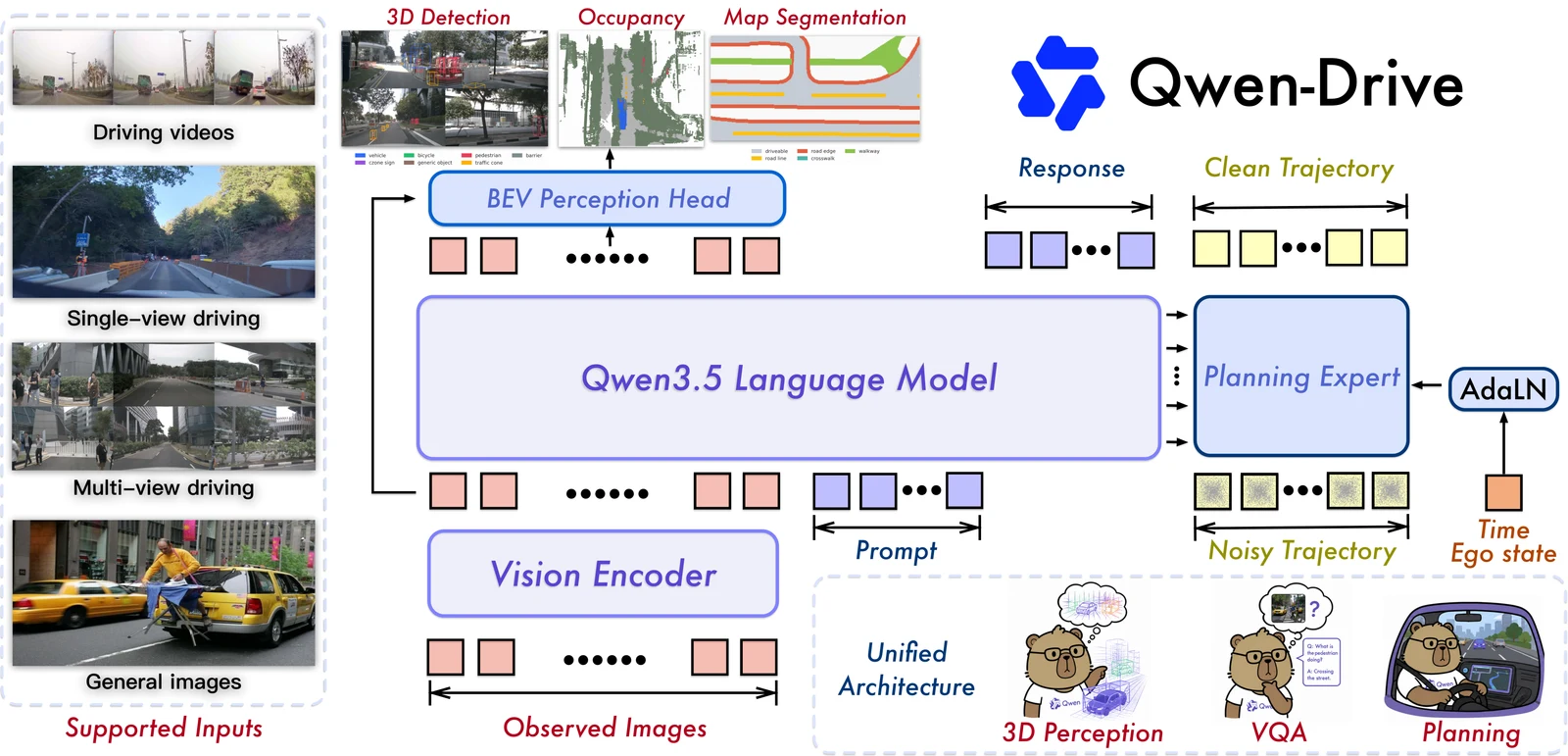
- The research builds on Qwen3.5-4B.
- It adds explicit perception and trajectory-planning modules.
The announcement
Qwen introduced Drive-1.0 on September 3 as a driving research model built on Qwen3.5-4B. The design retains the pretrained vision-language architecture while adding an external bird’s-eye-view perception head and a Planning Expert for future trajectories. The team reports evaluations in perception, driving questions and motion planning. It also identifies consistency between textual reasoning and generated trajectories as an area needing improvement. This is a research release, not a road-deployment certification.
Editorial context
A system can describe a road scene sensibly while producing a trajectory that does not match that description. Making perception outputs inspectable could help researchers investigate the gap. The useful editorial question is whether the different representations agree on the same situation, particularly when the scene contains ambiguity or information that is hard to see.
Editorial context: what to watch
Further work would benefit from transparent failure analysis across weather, geography and unusual traffic situations. Open-loop prediction scores and behavior in an interactive simulation answer different questions, so both should retain their labels. Independent tests would clarify how much of the reported progress transfers beyond the published datasets and where the approach still requires substantial engineering.
Sources: Qwen: Drive-1.0 official research announcement, September 3 ↗