BOSS Zhipin’s Nanbeige releases a 33B model for coding and office agents
Nanbeige4.3-33B brings downloadable Apache-2.0 weights and a 512K context window. The lab plans to use it as a teacher for smaller agents.
THE STORY IN THREE POINTS
- Nanbeige is the large language model research team at BOSS Zhipin, according to its official organization page.
- The 33.1B-parameter model and its Base checkpoint are downloadable; the configuration supports 524,288 tokens.
- Published coding and cowork results are the lab’s own measurements, with evaluation settings disclosed in its model card.
A release from BOSS Zhipin’s model research team
Nanbeige LLM Lab announced Nanbeige4.3-33B through its official account on October 25. Its Hugging Face organization page identifies Nanbeige as BOSS Zhipin’s large language model research team, confirming the connection to the recruitment platform.
The public repository was created on October 24, before the announcement. Checked on October 26, it contains model weights, a tokenizer and configuration files. Repository creation, the public announcement and this article’s publication are separate dates.
Build a stronger teacher before a smaller student
The lab’s launch message describes the 33B model as a teacher for a planned generation of smaller agents, beginning with Nanbeige4.3-3B. The strategy is to develop stronger agent behavior at a larger size, then transfer capabilities through distillation. The announcement does not establish the future student model’s performance or give it a release date.
A separate Nanbeige4.3-33B-Base repository provides the starting checkpoint for post-training. Its description explicitly invites both general-purpose and domain-specific agent development. Developers should distinguish that base checkpoint from the released assistant model when selecting an artifact.
What is available to download
Hugging Face’s repository metadata records 33,118,977,024 parameters in BF16, or approximately 33.1 billion. The published configuration sets the context capacity to 524,288 tokens, commonly described as 512K. This is a text-generation model; a long window does not by itself demonstrate reliable recall over every part of a document.
The file listing contains fourteen Safetensors weight shards and reports a repository size of about 66.3 GB. Both assistant and Base pages identify an Apache-2.0 license. Download size is not a GPU-memory requirement: runtime memory also depends on context, concurrent requests and the serving implementation.
Strong reported agent scores, with visible exceptions
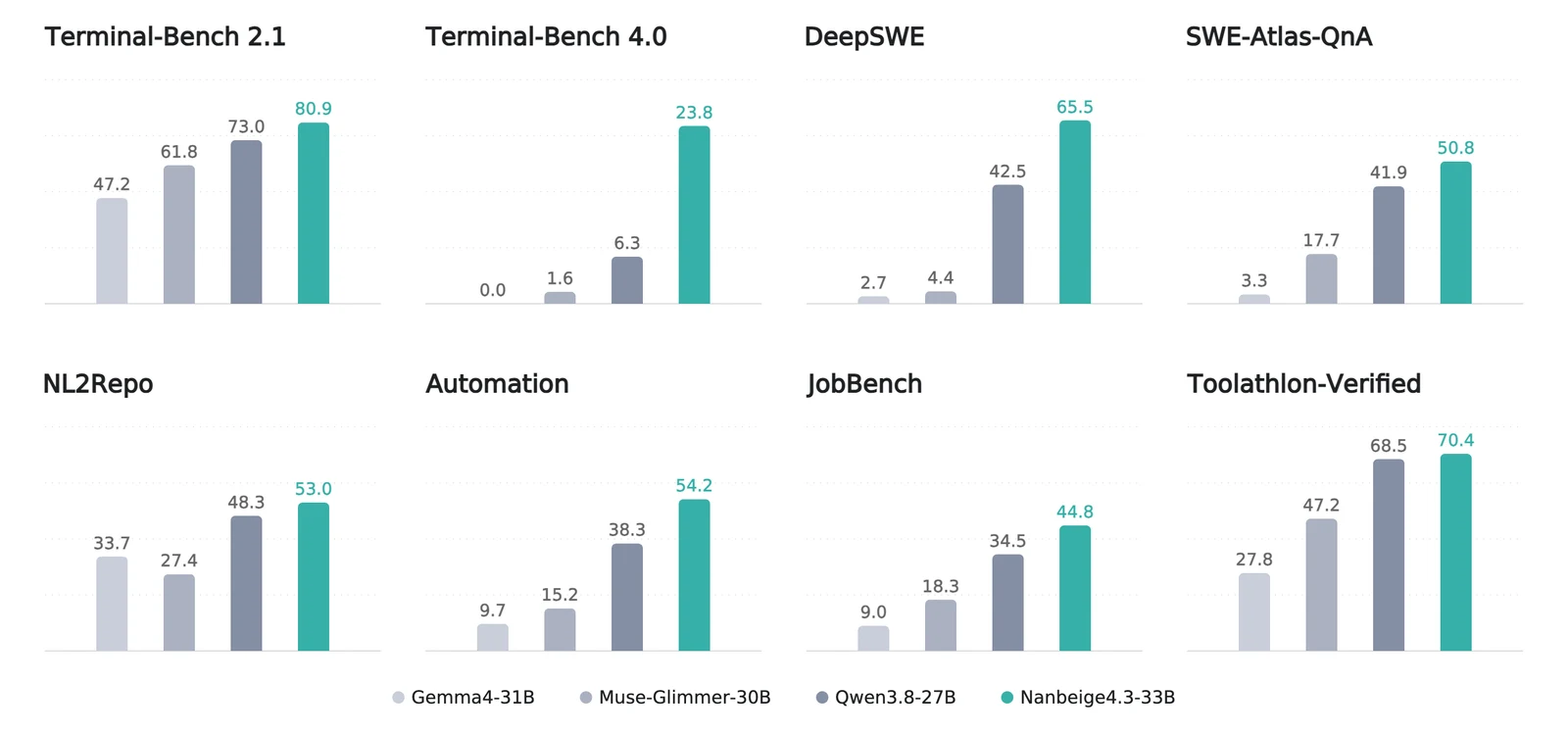
The lab reports 80.9 on Terminal-Bench 2.1, 65.5 on DeepSWE and 54.2 on Automation Bench, versus Qwen3.8-27B’s 73.0, 42.5 and 38.3 in its comparison. Qwen remains ahead on SWE-Bench Pro and GDPval. These are supplier-run evaluations, not an independent ranking.
The card says models use their highest thinking effort and matched settings within each benchmark. Nanbeige uses preserve_thinking=true; Terminal-Bench 2.1 uses Terminus 2, while Terminal-Bench 4.0 and DeepSWE use mini-swe-agent v2.4.6. Harness differences matter when comparing results with other announcements.
Thinking history and deployment settings matter
For multi-turn tools and office work, the model card recommends retaining previous reasoning with preserve_thinking=true. It favors XML tool calls, while also supporting JSON. Agent-task sampling uses temperature 1.0 and top_p 0.95, with a 65,536-token generation cap.
Examples cover Transformers, SGLang and vLLM; the serving examples use four-way tensor parallelism. They demonstrate a configuration, rather than a universal hardware minimum. The launch’s cost-efficiency claim is not accompanied by a public token-price schedule or a measured cost-per-completed-task comparison.
Editorial context: evaluate the workflow and the eventual student
Our assessment is that the immediate opportunity is testing a downloadable model on repeatable coding and office tasks. Keep the harness, reasoning-history policy and review criteria consistent, and measure successful completion alongside latency and resource use. A benchmark improvement is useful only when it survives the workflow a team actually runs.
The longer-term question is how much of the teacher’s capability reaches the planned smaller model. Until that artifact and its own evaluation are published, the 33B results describe the teacher. They provide an evaluation starting point for a future student release, rather than evidence of its capabilities today.
Sources: Nanbeige: official launch announcement, October 25 ↗ Nanbeige: official organization and BOSS Zhipin affiliation ↗ Nanbeige4.3-33B: model card, benchmarks and deployment examples ↗ Nanbeige4.3-33B: published architecture and context configuration ↗ Nanbeige4.3-33B: downloadable weight shards and files ↗ Hugging Face: repository metadata and exact parameter count ↗ Nanbeige4.3-33B-Base: official base checkpoint ↗