Tibo says Codex and Work now keep prompt caches forever
Signed-in users are promised cache hits when returning to old conversations. OpenAI’s website separately documents a new 12-hour caching option for the Responses API.

THE STORY IN THREE POINTS
- Tibo says signed-in Codex and Work users keep prompt caches indefinitely when resuming conversations.
- OpenAI’s API changelog confirms a separate 12-hour caching option introduced on October 20.
- API cache-write rates and Codex credit billing follow different rules.
What Tibo announced
In his Day 16 update, Tibo (@thsottiaux) said logged-in Codex and Work users would retain their caches indefinitely. His phrase was “we keep cache forever.” He said users returning to an old conversation, or continuing after several hours, would no longer face a penalty from that gap and would be guaranteed a cache hit.
The post was published at 01:10 UTC on October 21, or 09:10 in Singapore. It paired the Codex and Work announcement with a separate API improvement. The promise concerns reusing conversation context; it does not announce a new model or expand a model’s context window.
What OpenAI’s website confirms
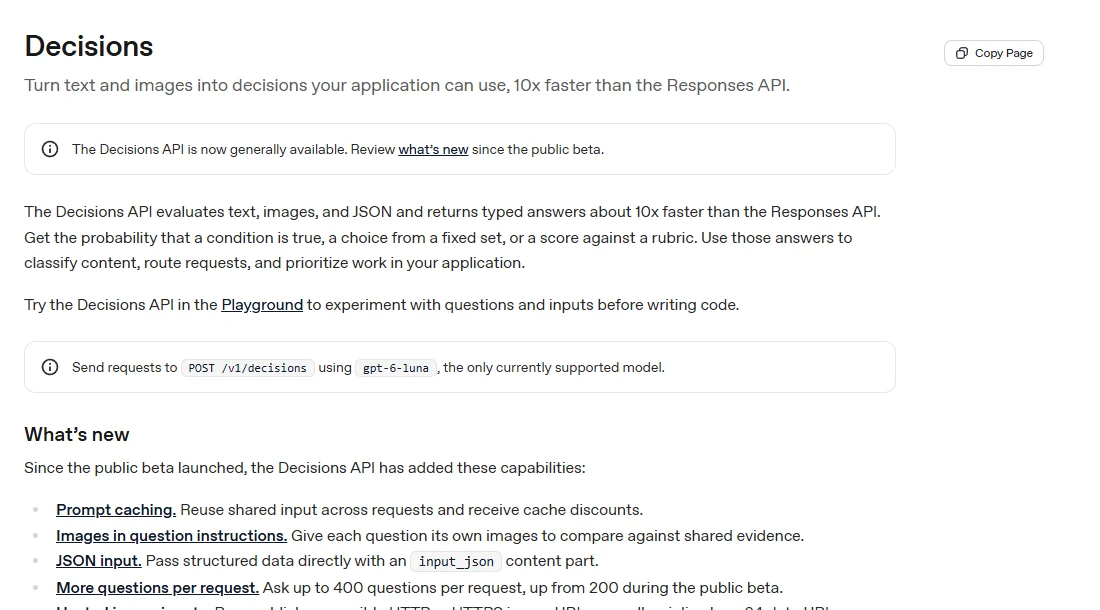
OpenAI’s API changelog dates the new 12-hour prompt-caching option to October 20. It is designed for applications that revisit shared instructions, tools and reference context throughout the day, including requests separated by hours. Developers choose the option in the Responses API.
The ChatGPT and Codex changelog checked for this report did not yet contain a matching permanent-cache announcement. The Codex and Work claim is therefore attributed to Tibo’s post. The published API policy and his signed-in product promise describe different access paths, and the API’s time limits should not be presented as the Codex product’s limit.
The API and Codex have different billing rules
For supported GPT-5.6-and-later models, the API guide lists a default 30-minute minimum lifetime and an optional 12-hour minimum. The corresponding cache-write rates are 1.25 times and 2.5 times ordinary input pricing. These are total write rates, not extra fees added to ordinary input. Reused input has a separate discounted rate.
Codex’s credit-pricing page says it has no separate cache-write charge; API-key usage follows API pricing. For example, its Standard-speed table lists GPT-6.1 Sol at 50 credits per million ordinary input tokens, 2.5 for cached input and 250 for output. This illustrates the value of reuse, rather than a promise that every resumed task uses fewer credits overall. The page also says credit rates alone do not determine a subscription’s included usage.
What a cache hit actually reuses
Prompt caching saves computation for an unchanged prefix of a request, including instructions and earlier context. OpenAI’s API guide describes cached key-value states rather than a saved final answer. New input and output still require processing. Reopening a conversation does not mean that future replies have already been generated.
For the API’s 12-hour setting, the guide distinguishes eligibility for cached-input pricing from guaranteed reuse of stored states or a latency improvement. Its documented minimum lifetime is also not a deletion deadline or an offer of indefinite API retention.
What the permanent-cache promise leaves open
Tibo’s short announcement does not explain where long-lived state is stored, how it is reconstructed, or whether the same behavior survives a model change, edited earlier messages or context compaction. It does not say that every past token remains inside the model’s active context. Claims about an always-resident GPU cache, unlimited memory or unlimited usage would go beyond the announcement.
Editorial context: a better reason to return to a task
The practical appeal is continuity. A developer can leave an investigation, collect more evidence and return to the same task without treating a long pause as a reason to start over. That matters for work that naturally spans reviews, meetings and overnight breaks.
A useful follow-up is to observe resumed tasks over different gaps while keeping the model and prior context stable. Compare cached-input usage, total credits and time to the first response separately. A guarantee about reuse and a claim about faster completion are different things; measuring both would show how the change feels in everyday work.
Sources: Tibo (@thsottiaux): Day 16 — API 12-hour caching and permanent caches for signed-in Codex and Work users ↗ OpenAI API changelog: October 20 — 12-hour prompt caching ↗ OpenAI API: Prompt caching — checked October 21 ↗ ChatGPT Learn: Codex pricing and cache-write billing — checked October 21 ↗ ChatGPT and Codex changelog — checked October 21 ↗ Independent public archive of Tibo’s post and UTC+8 timestamp; used to cross-check text while direct X retrieval was unavailable ↗